

The phrase “200 hour yoga teacher training” is used so often that most people never ask the obvious question: two hundred hours of what? It is a fair question, especially if you are about to spend three or four weeks and a meaningful amount of money on it. Here is the syllabus, subject by subject, as it is taught in a traditional residential school. 1. Asana, in two traditions Most reputable schools build the practical work on two pillars. Hatha yoga is the traditional, structured approach: postures held with steadiness, built slowly, with attention to what the body is actually doing. Ashtanga Vinyasa is the flowing, breath-led counterpart, a set sequence practised until the body knows it by heart. Learning both is deliberate. One teaches you to hold, the other teaches you to move, and a teacher needs both vocabularies. 2. Alignment and adjustment This is where a student turns into a teacher. You learn how a posture is entered and left safely, what changes for different body types, and how to place your hands on another human being without causing harm. It is usually taught in the Iyengar approach, which is precise about angles, props and sequencing. Trainees often describe a single quiet correction here as the moment everything clicked. 3. Pranayama and shatkarma The classical breathing practices and cleansing techniques. Taught properly, this is a science with contraindications, not a set of tricks. Mornings in a residential course usually open with breathwork before any movement, because a settled nervous system changes the quality of everything that follows. 4. Anatomy and physiology The living body you are going to be teaching. Skeletal structure, joint mechanics, the muscles involved in common postures, and the injuries that careless teaching causes. Any course that skips this or hands it to a non-specialist should be treated with suspicion. 5. Philosophy The Sutras of Patanjali, the Bhagavad Gita and older texts, read slowly and discussed as a practical map of the mind rather than as scripture to be memorised.
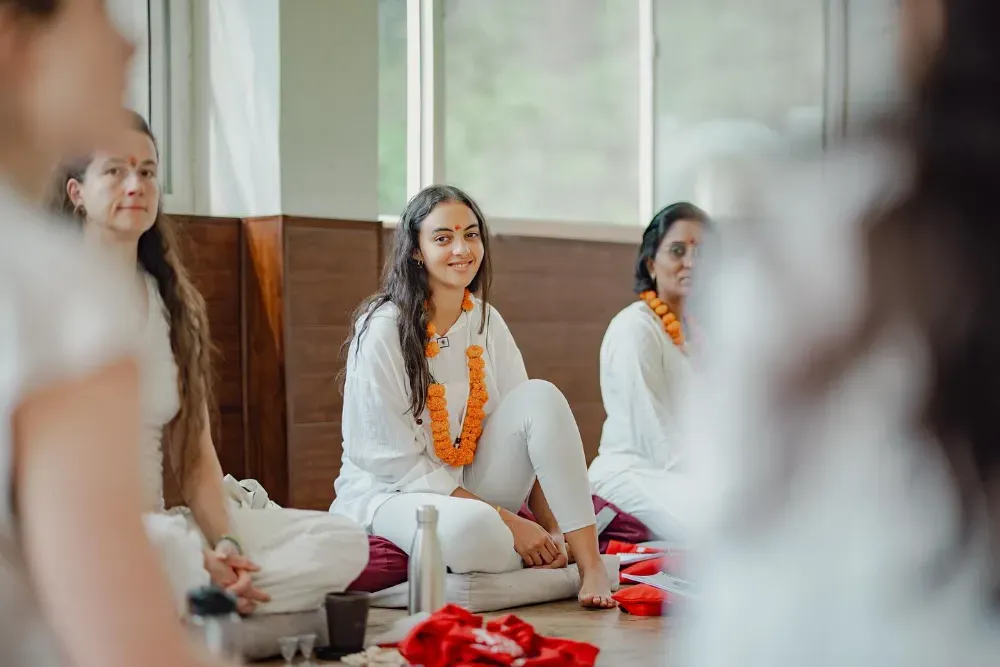
This is the subject students expect to find dull and most often end up loving. 6. Meditation, mantra and restorative practice The quiet half of the work: seated practice, chanting, and fully supported restorative postures that teach the nervous system how to switch off. In a well-designed day these are placed in the afternoon and evening, when the body is tired and receptive. Adhiroha Yoga School ·. Teaching methodology and practicum The final and most nerve-wracking piece. You learn to sequence a class, use your voice, watch a room, and handle the student who cannot do what you just demonstrated. By the last week of a good 200 hour yoga teacher training in rishikesh, you will have taught a full class to your peers on your own — and most trainees are surprised by how natural it feels. How the hours are distributed Twenty-four days is typical for a residential course, structured so that the physically demanding sessions land in the cool morning and the theory sits in the middle of the day. Roughly speaking, expect the largest share of contact hours in asana and teaching practice, with anatomy, philosophy and pranayama each holding a substantial block of their own. A note for people who never intend to teach A large number of students take the 200 hour course purely to deepen their own practice, with no plan to teach anyone. That is a completely legitimate use of it. The foundation-level syllabus is simply the most complete, structured education in yoga available in a single month, and the certificate is a by-product rather than the point. If you are choosing between schools, ask for the hour-by-hour syllabus in writing before you pay. Any school proud of its teaching will send it without hesitation.